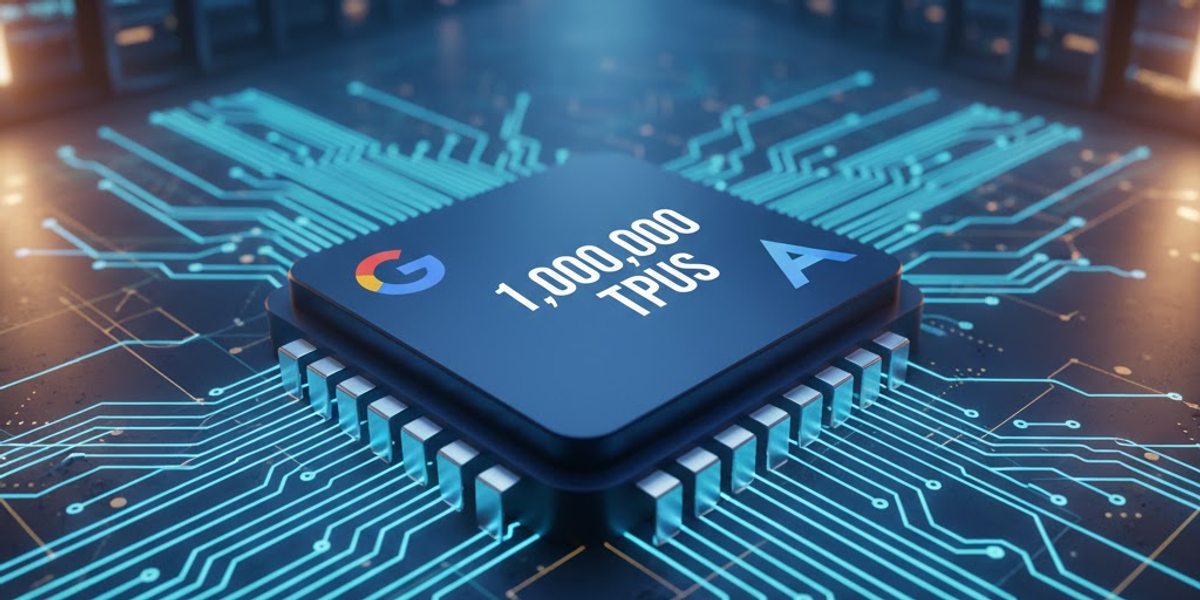
Anthropic Seals Massive AI Chip Deal: Up to 1 Million Google TPUs to Power Claude's Future
The AI Arms Race Heats Up: Anthropic Seals Massive Deal for 1 Million Google TPUs
Anthropic’s Multi-Billion Dollar AI Chip Deal with Google Signals a New Era of Compute Power
In the relentless "compute gold rush" driving the artificial intelligence industry, the cost of training the next generation of large language models is soaring. In a move that cements a key strategic partnership and validates Google’s hardware ambitions, AI startup Anthropic—the creator of the Claude chatbot—has signed a groundbreaking deal to dramatically expand its use of Google’s custom-designed AI chips.
This partnership isn't just a big transaction; it's a statement about the future of AI infrastructure.
The Mind-Boggling Scale of the Anthropic AI Chip Deal
The core of the agreement revolves around securing the most sought-after resource in tech today: high-performance silicon.
While the exact final figure is confidential, sources confirm this is a multibillion-dollar expansion that secures immense resources for Anthropic's growth. The deal's key specifics are truly staggering:
- Up to One Million TPUs: Anthropic will gain access to as many as one million of Google’s specialized chips, known as Tensor Processing Units (TPUs). These custom processors are designed to be an efficient alternative to Nvidia’s highly demanded GPUs for training massive AI models.
- A Gigawatt of Power: The deal is expected to bring well over a gigawatt of computing capacity online by the end of 2026. To put that in humanized terms, that is an astronomical amount of energy dedicated solely to fueling the brain of one of the world's most competitive AI systems.
- Purpose: The resources will be used for both the intensive Anthropic Claude model training and serving its rapidly expanding base of over 300,000 business customers.
Why Anthropic Chose Google TPUs for Claude Model Training
Anthropic, founded by former OpenAI leaders, has been one of the fastest-growing companies in the generative AI space. The choice to massively expand its compute resources with Google, in which the tech giant is also an investor, was a deliberate one focused on efficiency and cost.
Anthropic executives cited the price-performance and efficiency of Google’s TPUs as a key reason for the decision, noting their long-standing positive experience in training and serving Claude models on the hardware.
For a startup valued at over $183 billion, scaling infrastructure efficiently is paramount. This influx of TPUs ensures that Anthropic can continue to meet the exponential demand for its Claude models while staying at the cutting edge of AI development and safety research.
Google's Strategic Win in the AI Infrastructure Market
This agreement is a powerful validation for Google's in-house hardware strategy, positioning its TPUs as a legitimate, large-scale competitor to the ubiquitous dominance of Nvidia's GPUs.
In the AI arms race, control over the supply chain is everything. By securing this massive order, Anthropic is simultaneously guaranteeing its future computing needs and providing a major public endorsement of Google Cloud’s AI infrastructure capabilities. It positions Google not just as an investor, but as an indispensable infrastructure provider in the ecosystem.
This dynamic also highlights a key trend in the future of AI infrastructure: companies are actively diversifying their compute strategy. While Anthropic reaffirms that Amazon Web Services (AWS) remains its primary training and cloud provider, the decision to commit so heavily to Google’s hardware demonstrates a necessity to use multiple platforms (Google TPUs, Amazon Trainium, and Nvidia GPUs) to acquire enough compute power to operate at this elite level.
The Broader Implications for the Future of AI
The sheer size of this deal underscores a critical reality for the AI industry: massive capital and massive hardware are required to stay competitive. Every major AI developer is grappling with the same scarcity of chips and the same skyrocketing operational costs.
This partnership between Anthropic and Google solidifies the two companies’ positions as major forces in the AI landscape, directly challenging rivals like Microsoft and OpenAI. It shows that in the race to achieve Artificial General Intelligence (AGI), securing a multi-pronged, multi-billion dollar strategy for compute power is the only way to play the game.
Ultimately, this Anthropic Google deal is more than a transaction—it is a clear sign that the infrastructure behind generative AI is entering a new, explosive phase of growth, making the competition to train smarter, faster models fiercer than ever.