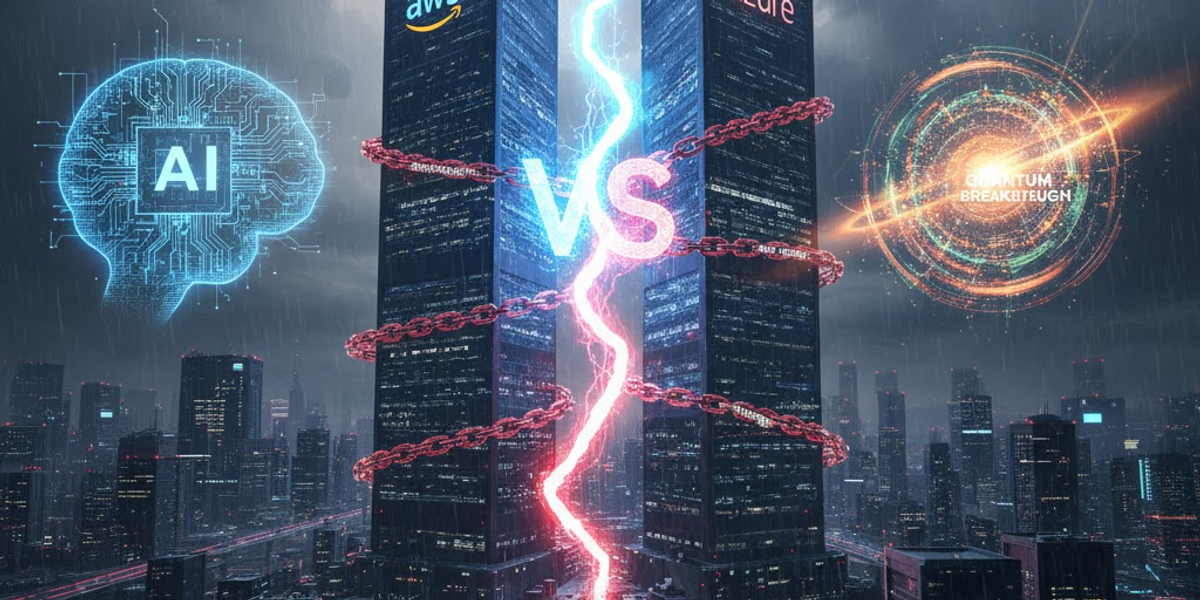
The Apex of Innovation: AI, Cloud Titans, and the Quantum Revolution
The Apex of Innovation: AI, Cloud Titans, and the Quantum Revolution
The current technology landscape is dominated by a high-stakes race in Artificial Intelligence (AI), highlighting both the immense power of major cloud providers and the disruptive promise of quantum computing. These two trends are not separate; they are deeply intertwined, defining the future of compute infrastructure and enterprise digital solutions.
The AI Race: Challenges for AWS, Azure, and Google Cloud
The world's leading cloud providers—Amazon Web Services (AWS), Microsoft Azure, and Google Cloud (often called the "hyperscalers")—are the central battleground for the AI revolution. Their primary challenges revolve around the sheer, exponential demand for compute power fueled by massive generative AI models.
1. The Capital Intensity and Compute Bottleneck
The foremost challenge is capital expenditure. Training and running state-of-the-art AI models require vast clusters of specialized hardware, primarily high-end GPUs.
- The Hardware Scarcity: Despite spending billions, these providers face a constant supply-demand mismatch for leading-edge chips (like those from NVIDIA). This bottleneck directly impacts their ability to serve enterprise customers and startups building new AI applications.
- The Custom Silicon Strategy: To overcome reliance on external suppliers and improve efficiency, all three major cloud providers are heavily investing in custom silicon.
- Google: Leads with its long-established Tensor Processing Units (TPUs), optimized specifically for its AI workloads.
- AWS: Develops its own chips like Trainium and Inferentia for training and inference, respectively.
- Microsoft Azure: Has joined the custom chip race with processors like Maia (for AI) and Cobalt (for general cloud tasks).
2. Infrastructure Scaling and Energy Demand
AI workloads are fundamentally different from traditional cloud computing. They require extreme power density, leading to massive infrastructure challenges:
- Data Center Densification: AI clusters demand specialized infrastructure with advanced cooling techniques (like liquid cooling) to manage the intense heat generated by densely packed GPUs.
- Power Grid Strain: The exponential energy consumption of AI is straining power grids and creating a major headache for sustainability goals and site selection for new data centers.
The Quantum Breakthrough: A New Computing Frontier
Adding to the complexity and excitement, quantum computing (QC) has seen significant progress, representing the next potential shift in high-performance computing.
Google's "Verifiable Quantum Advantage"
In a recent landmark development, Google claimed to have achieved the first-ever demonstration of "verifiable quantum advantage" (sometimes called "beyond-classical computation").
- The Breakthrough: Using a quantum chip, Google's "Quantum Echoes" algorithm performed a complex physics simulation 13,000 times faster than the best known classical algorithm running on the world's fastest supercomputers.
- Significance: This achievement is a critical step toward "useful quantum computing." While the initial task was highly specialized (simulating molecular interactions, valuable for drug discovery and materials science), it proves the principle of QC's immense speedup on certain problems.
Relevance to AI and Cloud
The quantum breakthrough is highly relevant to the AI race:
- Quantum-Enhanced AI: Quantum computers are not expected to replace classical computers, but to function as specialized accelerators integrated into cloud environments. They can solve optimization problems and simulate complex data (like molecular structures) far beyond classical AI's reach. This unique, high-fidelity data can then be used to train and make classical AI models more powerful.
- The Threat and the Opportunity: The advancement of QC also poses a serious long-term threat to current encryption methods, spurring the development of Post-Quantum Cryptography (PQC) solutions by the same cloud providers.
Conclusion: The Convergence of Compute
The tech narrative today is defined by the convergence of these three pillars:
- The Cloud Titans are locked in an intense, expensive battle to build out the AI infrastructure of the present (custom silicon and optimized data centers).
- Quantum Computing is now offering tangible proof of its potential to define the infrastructure of the future, promising speedups that will make today's supercomputers look slow.
The companies that can successfully bridge these two worlds—integrating AI services and future quantum capabilities into their scalable cloud platforms—will ultimately lead the next era of technological advancement.