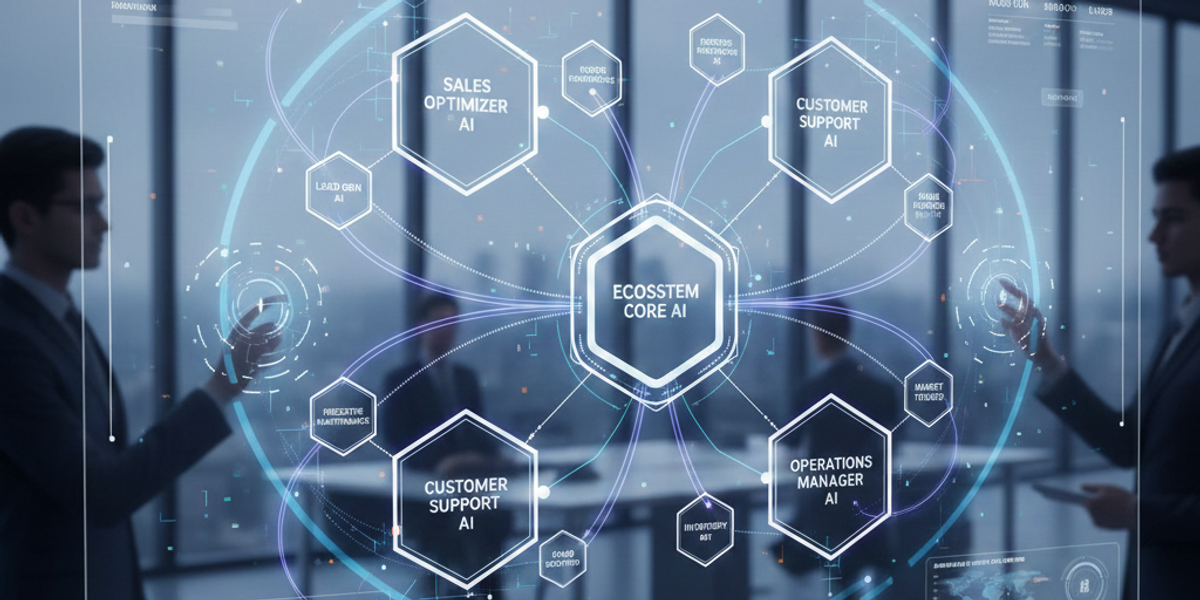
Why Every B2B Company Will Have an AI Agent Stack by 2027
Introduction
The way B2B companies operate is changing faster than ever. What started with basic automation has now evolved into something far more powerful — AI agents working together as an intelligent system.
By 2027, having a website or a CRM won’t be enough. Every competitive B2B company will rely on an AI agent stack — a collection of intelligent agents that manage sales, operations, customer support, analytics, and decision-making.
At EvoTech Studio, we see AI agent stacks becoming the new digital backbone for modern businesses.
What Is an AI Agent Stack?
An AI agent stack is a group of specialized AI agents, each responsible for a specific business function, working together seamlessly.
Instead of using disconnected tools, companies deploy AI agents for:
- Sales and lead qualification
- Customer support and retention
- Marketing optimization
- Operations and workflow management
- Data analysis and decision support
These agents communicate with each other, learn continuously, and optimize workflows automatically — without constant human intervention.
Why Traditional Automation Is No Longer Enough
Traditional automation relies on fixed rules and predefined workflows. While useful, it struggles with:
- Changing customer behavior
- Complex decision-making
- Cross-platform coordination
- Scalability at speed
AI agents go beyond automation. They understand context, adapt to outcomes, and make decisions, which is why businesses are shifting toward full AI agent stacks instead of single-purpose tools.
Key Reasons Every B2B Company Will Adopt AI Agent Stacks
1. Businesses Need Fewer Tools, Not More
B2B teams are overwhelmed by dashboards, subscriptions, and manual processes. AI agent stacks reduce tool overload by managing multiple systems in the background.
Result: Lower software costs and simpler operations.
2. Speed Is Becoming a Competitive Advantage
AI agents operate 24/7, responding instantly to data and events. Whether it’s following up with leads or resolving customer issues, speed matters.
Result: Faster execution and better customer experiences.
3. Data-Driven Decisions, Not Guesswork
AI agents continuously analyze KPIs, trends, and performance metrics, providing real-time recommendations instead of static reports.
At EvoTech Studio, we help businesses shift from dashboards to decision-driven AI systems.
4. Scalability Without Hiring Pressure
As businesses grow, scaling teams becomes expensive and complex. AI agent stacks allow companies to scale operations without proportionally increasing headcount.
Result: Higher productivity with controlled costs.
Real-World Use Cases of AI Agent Stacks
Sales & Marketing
AI agents qualify leads, personalize outreach, optimize campaigns, and predict conversion likelihood — all automatically.
Customer Support
AI agents detect issues early, solve problems instantly, and escalate only when human involvement is needed.
Operations & Management
AI agents optimize workflows, predict delays, and allocate resources intelligently across departments.
Why 2027 Is the Tipping Point
Several factors are accelerating adoption:
- Mature large language models (LLMs)
- Better system integrations and APIs
- Increased trust in AI decision-making
- Rising operational complexity in B2B
By 2027, companies without AI agent stacks will struggle to compete with those operating at AI-driven speed.
Challenges to Consider
AI agent stacks must be implemented strategically:
- Clear governance and monitoring are essential
- High-quality data ensures accurate outcomes
- Ethical AI practices build trust and compliance
A thoughtful implementation ensures AI supports human teams instead of replacing them.
The Role of EvoTech Studio
At EvoTech Studio, we help B2B companies design, integrate, and scale AI-first systems tailored to their workflows. Our focus isn’t just automation — it’s building intelligent digital ecosystems that grow with your business.
Conclusion
AI agent stacks are quickly becoming a necessity, not a luxury. By 2027, they will be a standard part of how successful B2B companies operate.
Businesses that adopt early will move faster, operate smarter, and scale more efficiently. Those that don’t risk falling behind.
The future of B2B isn’t about more tools — it’s about intelligent systems. And that future is being built today.
About the Author
